Best Luxury Business Hotels with Executive Lounges in London

The global commercial architecture relies heavily on high-frequency physical presence within premier financial capitals, where complex capital allocation and strategic negotiations unfold across dense urban corridors. When multinational enterprises deploy senior deal teams, institutional investors, and legal counsel to London, the management of working capital must harmonize seamlessly with the preservation of executive stamina. Operating across overlapping time zones in a demanding international marketplace transforms temporary accommodation from a passive lodging choice into a critical operational asset. Securing an environment that combines absolute data privacy, acoustic isolation, frictionless transport connectivity, and responsive administrative infrastructure is vital for sustaining peak cognitive performance under intense pressure.
Within this landscape, the executive lounge functions far beyond a mere hospitality amenity; it represents a specialized, controlled enclave designed to streamline deal-making and mitigate the logistical friction inherent in cross-border commerce. However, identifying the options that consistently deliver requires an analytical approach that pierces through surface-level marketing gloss. Corporate travel managers and executive assistants must evaluate properties based on strict operational metrics, including private meeting room availability, high-bandwidth network segmentation, culinary timing precision, and discrete check-in workflows. A failure to scrutinize these variables can introduce compounding inefficiencies that disrupt multi-million-dollar transactions.
Evaluating the top tier of executive hospitality across the British capital demands an understanding of how distinct districts—from the historic legal heart of Holborn and the traditional banking hub of the City of London to the modern skyscrapers of Canary Wharf and the diplomatic enclaves of Mayfair—shape an executive’s daily workflow. This reference guide deconstructs the systemic evolution, conceptual frameworks, financial dynamics, and risk-management strategies governing the selection of elite business accommodations across the metropolitan area.
Best Luxury Business Hotels with Executive Lounges in London
When evaluating the Best Luxury Business Hotels with Executive Lounges in London, one must first decouple traditional leisure hospitality criteria—such as opulent decorative art, celebrity chef partnerships, or expansive spa facilities—from true corporate functionality. In a leisure context, a hotel is judged on sensory indulgence and atmospheric escapism. In corporate finance and institutional advisory work, however, a top-tier business hotel is evaluated as a secure, highly specialized operational base designed to protect confidential data, minimize transit friction, and maximize billable hour productivity across disruptive time shifts.
A frequent oversight among corporate travel planners is relying entirely on brand reputation or global luxury star ratings when booking for financial executives. A heritage grand hotel located in a fashionable West End shopping district may offer exceptional aesthetic charm, yet prove entirely unviable for a private equity team needing to reach a legal advisory office in the City of London within a tight window during morning rush-hour gridlock. True business efficiency demands spatial integration with commercial districts, requiring properties equipped with dedicated corporate check-in bypasses, secure document printing stations, private boardrooms featuring advanced multi-point video conferencing arrays, and soundproofed perimeter architecture.
Furthermore, oversimplifying selection criteria by prioritizing proximity alone can introduce severe acoustic and digital liabilities. A hotel situated directly above a major underground transit interchange may offer unbeatable walking times, but suffer from low-frequency structural vibrations, unstable Wi-Fi bandwidth contention during peak data-load hours, or a lack of discrete private entrances required for executives maintaining high personal security profiles. A rigorous evaluation framework balances micro-location geography against digital redundancy, acoustic engineering, privacy shielding, and concierge-level administrative support.
Evolution and Context of London’s Business Hospitality
The structural evolution of corporate hospitality across London spans three distinct operational eras, reflecting shifts in telecommunications technology, corporate governance standards, and the globalization of banking.
During the late nineteenth and early twentieth centuries, London’s financial core relied on grand railway terminus and exchange hotels that catered to industrialists, bankers, and visiting merchants. These properties emphasized public opulence, serving as social extensions of the trading floor where deals were struck over formal dinners. Rooms were modest in workspace capability because physical paperwork and face-to-face negotiation dominated the pre-digital workflow.
The deregulation and financial globalization waves of the late twentieth century triggered a radical transformation in business hotel architecture across the capital. As international capital flows accelerated and multinational banks established dominant multi-continental footprints in both the City and Canary Wharf, the demand for standardized executive amenities surged. Hotels introduced dedicated executive club floors, business centers equipped with early facsimile machines, and multi-line direct dial telephone systems.
The contemporary era is defined by hyper-connectivity, cybersecurity vulnerabilities, and the blurring of boundaries between private workspace and temporary residence. Modern executive properties must function as secure digital nodes capable of supporting encrypted virtual data rooms, seamless cross-border streaming, and round-the-clock operational readiness. As financial and legal hubs continue to evolve, hospitality design has adapted to provide frictionless integration with subterranean transit networks, executive aviation coordination, and biometric security perimeters.
Key Categories of London Properties
Executive properties located near London’s major business districts vary widely in structural design, ownership models, service delivery, and target corporate clientele.
Integrated Financial Core Flagships
Properties physically integrated into commercial banking towers or modern mixed-use developments represent the pinnacle of transactional efficiency. By sharing elevator banks or podium levels with financial institutions, these hotels allow executives to transition from bed to boardroom without stepping foot on a public street.
Heritage Grand Domiciles with Modern Executive Refits
Historic luxury properties located in central London update their classic architecture with modern executive infrastructure. They provide exceptional prestige and established relationships with elite legal and financial advisory firms, though older floor plans can sometimes impose structural limitations on room layouts.
Canary Wharf Modernist Towers and Mayfair Boutiques
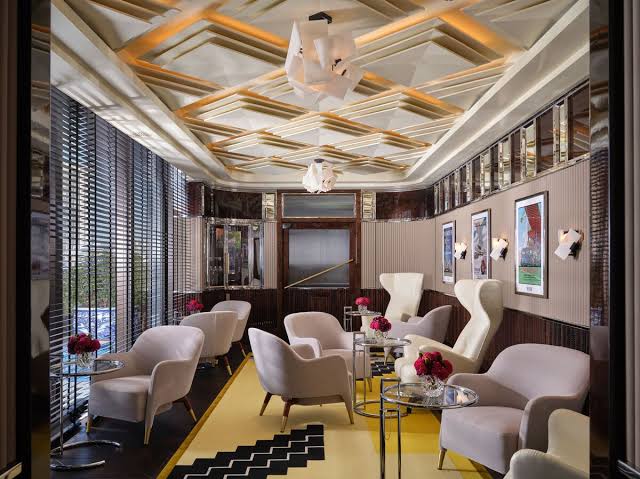
Purpose-built glass-and-steel skyscrapers situated in London’s eastern financial district offer cutting-edge technology and superior acoustic shielding, while Mayfair boutique properties focus on absolute discretion, personalized concierge attention, and refined aesthetic calm for executive board retreats.
Risk Landscape and Operational Failure Modes
Operating within high-density financial districts introduces unique operational, digital, and physical risks. Understanding common failure points prevents executive disruption.
-
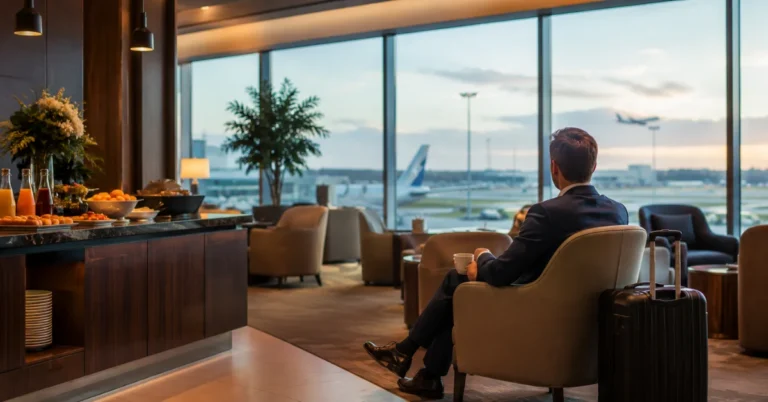
The Executive Lounge Eavesdropping Vulnerability: Financial executives frequently conduct sensitive client discussions in hotel executive lounges. Ambient noise combined with close seating configurations creates severe exposure to corporate espionage or casual eavesdropping.
-
Digital Data Caching on Hotel Hardware: Modern hotel rooms and executive lounge meeting spaces feature smart televisions and multi-media hubs that sync with executive devices. If these systems are not thoroughly wiped upon departure, confidential presentations can remain cached.
-
Executive Lounge Capacity Bottlenecks: During peak corporate travel seasons or major financial conferences in London, executive lounges can experience severe overcrowding, rendering private workstations unavailable and degrading the quiet working environment.
Governance, Maintenance, and Strategy
For corporate travel managers and executive operations directors overseeing global travel portfolios, maintaining an optimized lodging program requires continuous audits and structured review cycles.
-
Audit LNR Compliance & Rate Parity: Reconcile corporate negotiated rates against spot-market bookings quarterly to ensure maximum cost-efficiency across primary financial hub properties.
-
Review Cybersecurity & Lounge Wi-Fi Standards: Conduct periodic technical security audits of preferred hotel network infrastructures to verify enterprise-grade encryption and isolation protocols.
-
Evaluate Transit Proximity Metrics: Analyze historical executive travel logs to measure actual door-to-boardroom transit times, re-evaluating property selections if traffic friction increases.
Conclusion and Strategic Synthesis
Selecting the optimal property among the Best Luxury Business Hotels with Executive Lounges in London demands a rigorous, analytical approach centered on temporal proximity, acoustic and digital security, executive lounge workflow integration, and physiological recovery. Surface-level evaluations based solely on brand prestige or decorative luxury fail to capture how a hotel performs when an executive must finalize a multi-billion-dollar deal under immense time pressure.
By aligning lodging procurement with the operational realities of global capital markets—prioritizing direct transit integration, secure network segmentation, and responsive executive support services—organizations can transform corporate travel from an unpredictable logistical challenge into a reliable operational advantage. Through disciplined planning, meticulous governance, and intellectual honesty regarding facility limitations, managing executive residence in the world’s premier financial capitals becomes a cornerstone of long-term commercial success.