How Much Does a Private Jet Charter Cost? (Complete Price Guide)
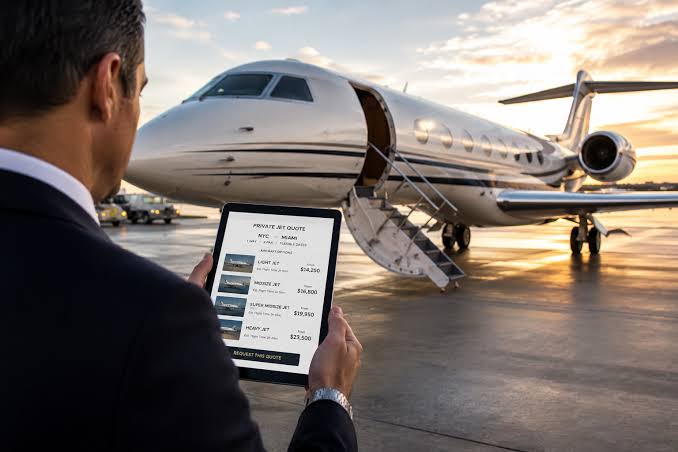
To evaluate How Much Does a Private Jet Charter Cost? (Complete Price Guide), one must first decouple public baseline estimates from fully burdened trip invoices. In casual discourse, private charter pricing is usually expressed as a single hourly rate—for instance, $3,500 per hour for a light jet or $10,000 per hour for a heavy jet. While these figures provide a baseline for preliminary aircraft category comparisons, they represent an incomplete picture of total expenditure.
A primary source of confusion for first-time charterers is the distinction between flight time and billable time. Flight time measures the exact duration from takeoff to touchdown. Billable time, however, includes flight time plus standard taxi allowances (typically 0.2 hours per leg), positioning legs required to move the aircraft to the origin airport, and daily minimum flight-hour guarantees (usually 1.5 to 2.0 hours per day). As a result, a two-city itinerary featuring a 45-minute flight on a jet with a two-hour daily minimum will be billed for the full two-hour minimum.
Furthermore, assessing private jet charter costs purely by comparing base quotes introduces severe financial risk. A provider offering a low hourly direct rate can prove economically disadvantageous if its quote omits repositioning fees, fuel adjustment surcharges, crew overnight per diems, or de-icing contingencies. A comprehensive cost evaluation balances baseline flight tariffs against positioning charges, guaranteed mechanical recovery clauses, seasonal pricing surges, and regulatory taxes.
Evolution and Context of Private Aviation Pricing
The economic frameworks governing private jet charter pricing have evolved across three distinct eras, driven by shifts in regulatory frameworks, computer dispatch technology, aviation fuel dynamics, and financial consolidation.
During the mid-twentieth century, private aviation operated primarily under localized air taxi models. Sourcing an aircraft required manual phone negotiations between regional brokers and fixed-base operators managing small, home-based fleets. Pricing was opaque and unstandardized. Clients paid for double-repositioning—funding the aircraft’s flight from its home base to the departure airport, the passenger leg, and the return flight back to the home base. One-way charters were rare and expensive because operators lacked the logistical systems to match returning legs with secondary clients.
The late 1980s and 1990s transformed industry economics with the introduction of fractional ownership models and pre-purchased Jet Card programs. Fractional ownership allowed buyers to purchase an equity share in a specific aircraft tail number while paying fixed hourly management and flight fees. Jet cards expanded this transparency by enabling clients to pre-purchase flight hour blocks at fixed, guaranteed hourly rates within a defined primary service area. This model shifted positioning risk from the client to the operator, as operators absorbed ferry costs inside their network boundaries.
The modern era is defined by dynamic software dispatch systems, global floating-fleet logistics, and capital consolidation. Operators manage large, non-home-based floating fleets that utilize predictive algorithms to minimize empty positioning flight hours. Simultaneously, open-market brokers utilize direct API links into operator scheduling software, offering real-time spot-market quotes. While this technology has increased price transparency, modern chartering requires navigating complex dynamic fuel surcharges, variable peak-day surcharges, and shifting regulatory tax structures.
Key Categories of Charter Aircraft
Private charter costs vary primarily by aircraft category, which dictates cabin volume, passenger capacity, range, speed, and baseline hourly rates.
Turboprops and Very Light Jets (VLJs)
Turboprops (e.g., King Air 350) seat 4 to 8 passengers with ranges of 1,100 to 1,800 nautical miles and hourly rates of $2,000 to $3,500 USD, offering excellent short-field airstrip access. Very Light Jets (e.g., Cirrus Vision Jet) seat 4 to 5 passengers, ideal for short regional hops of 1 to 2 hours at $2,900 to $4,600 USD per hour.
Light and Midsize Jets
Light jets (e.g., Phenom 300) carry 6 to 8 passengers across 1,500 to 2,100 nautical miles at $3,500 to $6,500 USD per hour. Midsize jets (e.g., Citation XLS+) accommodate 7 to 9 passengers with full stand-up cabins, offering ranges up to 3,000 nautical miles at $5,000 to $8,500 USD per hour.
Super-Midsize, Heavy, and Ultra-Long-Range Jets
Super-midsize jets (e.g., Challenger 350) deliver coast-to-coast nonstops for 8 to 10 passengers at $7,500 to $12,000 USD per hour. Heavy jets (e.g., Gulfstream G450) and Ultra-Long-Range jets (e.g., Global 7500) seat 10 to 19 passengers across intercontinental ranges up to 7,750+ nautical miles, with hourly rates spanning $8,500 to $20,000+ USD.
Real-World Scenarios and Decision Logic
Scenario 1: Short Regional Weekend Trip (New York to Miami)
A group of four travels round-trip from Teterboro to Miami Opa-locka over three days on a Light Jet. Flight time is 2.5 hours each way (5.0 total hours). At $4,500/hr, baseline flight charges equal $22,500. Adding taxi allowances, US Federal Excise Tax (7.5%), segment fees, landing charges ($500), and crew overnight per diems brings the fully burdened invoice to roughly $28,000 to $32,000 USD.
Scenario 2: One-Way Transcontinental Flight (Los Angeles to New York)
Eight executives book a one-way trip from Van Nuys to Teterboro on a Super-Midsize Jet. The 5.0-hour flight billed at $8,500 per billable hour plus Federal Excise Tax and domestic segment fees results in a total one-way invoice of approximately $42,500 to $48,000 USD.
Planning, Cost Dynamics, and Capital Accounting
Building a private aviation budget requires auditing both direct flight charges and variable operational line items.
-
On-Demand Spot Charter: Floating market rate per trip with zero upfront deposit. Clients pay repositioning costs on non-matching routes, but retain complete freedom to select aircraft per mission.
-
Fixed-Rate Jet Cards: Locked hourly rates within a primary service area backed by $25,000 to $250,000 upfront deposits. Positioning costs are absorbed by the provider within network boundaries.
-
Fractional Ownership: Substantial asset investment ($500,000 to $5,000,000+) yielding lower hourly flight rates and zero positioning charges within program areas, backed by maximum schedule priority.
Risk Landscape and Operational Hidden Fees
Navigating private charter pricing requires identifying financial risks and hidden fee structures that can unexpectedly inflate invoices.
-
Aircraft De-Icing Contingency Costs: Cold-weather operations require mandatory de-icing fluid applications billed post-flight, ranging from $1,500 on light jets to over $15,000 per application on heavy jets at major winter hubs.
-
Aircraft On Ground (AOG) Mechanical Upcharges: If an aircraft suffers a mechanical failure, low-quality charter contracts pass the price difference of sourcing a more expensive replacement jet directly to the client.
-
Pre-Paid Fund Exposure: Depositing funds with financially unstable brokers exposes clients to total loss if the provider faces insolvency before flights are executed.
Governance, Maintenance, and Strategy
For corporate travel desks, family offices, and wealth managers overseeing flight budgets, maintaining cost discipline requires structured audit workflows.
-
Audit All-Inclusive Quote Line Items: Verify that written quotes explicitly state whether taxes, landing fees, ramp handling, fuel surcharges, and crew per diems are included.
-
Confirm AOG Mechanical Recovery Terms: Review contract terms to ensure the operator absorbs financial upcharges for replacement aircraft during mechanical failures.
-
Verify Segregated Escrow Account Protections: Require confirmation that pre-deposited jet card or charter funds are held in independent, audited escrow accounts.
Conclusion and Strategic Synthesis
Understanding How Much Does a Private Jet Charter Cost? (Complete Price Guide) requires evaluating total operational expenditures rather than relying on surface-level baseline hourly rates. Private charter pricing reflects an intricate interaction of airframe category, mission distance, positioning requirements, regulatory taxes, and seasonal market dynamics.
By analyzing fully burdened cost structures, evaluating booking access models, verifying AOG mechanical recovery guarantees, and utilizing secondary general aviation airports, corporate travel managers and private individuals can control aviation budgets while preserving physical mobility. Through disciplined governance, invoice auditing, and intellectual clarity regarding pricing mechanics, private aviation becomes a predictable, highly effective operational asset.