Best VIP Travel Concierge Services for High-Net-Worth Travelers
Global mobility for ultra-high-net-worth individuals and corporate leadership operates far beyond the mechanics of standard premium travel. When corporate principals, multi-generational family offices, public figures, and sovereign investors cross international borders, transit ceases to be a simple sequence of commercial tickets and hotel reservations. It functions instead as a complex operational envelope where physical security, data privacy, diplomatic protocol, schedule agility, and cognitive recovery must be continuously balanced. A single friction point—a delayed private jet permit clearance, an unvetted villa security perimeter, or a public terminal bottleneck—can disrupt multi-million-dollar transactions or compromise personal safety.
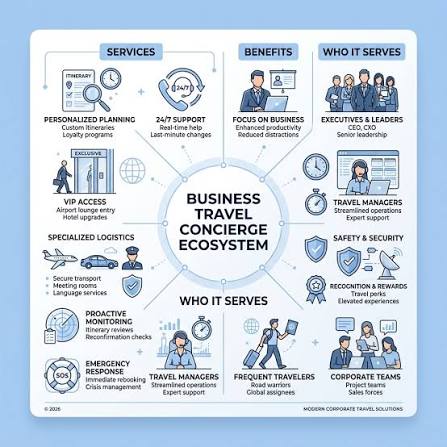
Within this high-stakes landscape, travel concierge services operate not as booking agencies, but as specialized lifestyle management firms and tactical execution networks. The term “concierge” has been widely diluted by consumer credit card perks and hotel desk operations. However, true elite travel management requires an intricate operational architecture. It demands direct access to decision-makers, private terminal ground handlers, diplomatic passport agencies, air charter operators, and local security details across dozens of global jurisdictions.
Evaluating the top tier of international travel concierge services requires an analytical approach that looks past glossy promotional portfolios. Ultra-high-net-worth travelers and their family offices must analyze providers based on structural capacity, service delivery models, crisis-recovery frameworks, network transparency, and data governance. This reference guide deconstructs the systemic evolution, conceptual frameworks, operational categories, cost dynamics, and risk-management protocols governing the world’s premier VIP travel concierge ecosystems.
Best VIP Travel Concierge Services for High-Net-Worth Travelers
When systematically defining the Best VIP Travel Concierge Services for High-Net-Worth Travelers, one must first decouple public lifestyle perceptions from high-level operational execution. In popular culture, travel concierges are frequently associated with securing last-minute tables at Michelin-starred restaurants or obtaining access to exclusive fashion shows. While soft-service access remains an expected baseline capability, true institutional value lies in the firm’s capacity to manage complex, multi-jurisdictional travel itineraries under severe time constraints, shifting regulatory environments, and elevated security profiles.
A primary source of operational friction for family offices and executive assistants is distinguishing between corporate travel agencies, card-linked concierge desks, and dedicated UHNW lifestyle management firms. Card-linked services rely on call-center aggregators operating within rigid scripts, lacking the authority or local connections to intervene when real-world disruptions occur. Conversely, dedicated VIP travel concierges maintain embedded local networks, proprietary ground handling agreements, and dedicated lifestyle managers who provide 24/7 proactive oversight.
Furthermore, oversimplifying provider selection by relying solely on brand recognition can introduce significant vulnerabilities. A massive global concierge conglomerate may possess expansive geographic coverage, yet suffer from high employee turnover, diluted personal attention, and third-party vendor outsourcing. On the other hand, an ultra-boutique firm might deliver exceptional personalized service in Western Europe while lacking the operational reach to manage emergency extractions or private aviation logistics in emerging markets. A rigorous evaluation framework balances global network reach against local operational autonomy, privacy protocols, and financial stability.
Evolution and Context of High-Net-Worth Mobility
The structural evolution of elite travel management spans three distinct operational eras, mirroring shifts in global wealth distribution, aviation technology, and international security standards.
During the late nineteenth and early twentieth centuries, luxury travel was defined by the Grand Tour era and classic luxury rail and ocean liner routes. Travel management was largely handled by grand hotel head concierges—such as those aligned with Les Clefs d’Or—and specialized regional shipping agents. Arrangements were linear, unhurried, and relied heavily on personal letters of introduction and local social status.
The mid-to-late twentieth century brought the democratization of commercial aviation and the rise of boutique travel agencies catering to the jet-set era. As corporate empires expanded globally, multinational executives and private investors required faster, more structured travel arrangements. This period saw the creation of specialized corporate travel desks and the early iterations of commercial credit card concierge programs designed to assist frequent international travelers.
The contemporary era, accelerating through the early twenty-first century, is defined by hyper-fragmentation, zero-trust digital security, and mobile command platforms. Modern ultra-high-net-worth mobility operates in a world of complex visa regimes, heightened biometric border controls, dynamic airspace restrictions, and intense public scrutiny. Today’s premier travel concierge services function as integrated operational centers capable of deploying private aviation, chartering mega-yachts, securing private islands, coordinating close-protection security details, and orchestrating emergency medical evacuations at a moment’s notice.
Key Categories of VIP Travel Services
Elite travel concierge providers vary widely in structural design, business models, target demographics, and functional specializations.
Ultra-Boutique High-Touch Curators
Firms that strictly cap their active membership roster (often charging substantial annual fees) to deliver hyper-personalized travel architecture. Founders and senior partners personally vet every hotel suite, private island, and yacht before recommending them to clients.
Global Multi-Service Lifestyle Management Groups
Expansive multinational platforms offering 24/7 lifestyle management across travel, real estate, education, private events, and art procurement. They operate dedicated offices in global financial capitals, making them ideal for high-net-worth individuals requiring continuous international support.
Direct Aviation, Yachting, and Corporate Security Integrators
Providers vertically integrated with private aviation fleets, yacht brokerage desks, and executive security teams. They excel at managing multi-modal transit itineraries involving continuous transfers between private jets, helicopter shuttles, mega-yachts, and close-protection ground details.
Real-World Scenarios and Decision Logic
Scenario 1: The Multi-Leg Private Island Family Gathering
A tech entrepreneur and their multi-generational family (fourteen guests across three age cohorts) plan a two-week holiday in a remote Caribbean archipelago during peak festive season. The family office engages an ultra-boutique travel curator. The concierge secures an unlisted private island estate, charters a dedicated regional aircraft for local island hops, coordinates custom dietary requirements with an imported private chef team, and manages pre-arrival customs clearances.
Scenario 2: Emergency Extraction During Geopolitical Instability
A private equity principal visiting a remote industrial asset in an emerging market encounters sudden regional political disruption, resulting in local airport closures. The principal contacts their global lifestyle group. The firm activates its crisis protocol, coordinating with a regional private security firm to transport the principal via overland vehicle to a secondary airfield, where a repositioned private jet evacuates them to neutral airspace.
Planning, Cost Dynamics, and Capital Accounting
Budgeting for top-tier VIP travel concierge services requires evaluating upfront membership retainers against variable trip execution expenses, vendor markups, and time-value savings.
-
Annual Membership Retainers: Fixed annual fees ranging from $10,000 (standard global lifestyle access) to $50,000–$100,000+ (ultra-boutique, capped-member services). Retainers cover dedicated lifestyle manager access, 24/7 availability, and trip architecture planning.
-
Direct Trip Execution Costs: Net expenses for accommodation, private jet chartering, yacht leases, security teams, and bespoke experiences, typically billed with transparent management fees or bundled package quotes.
-
Emergency Service and Custom Surcharges: Additional fees applied for short-notice bookings (under 48 hours), high-risk destination coordination, or complex legal/diplomatic filings.
Risk Landscape and Operational Failure Modes
Deploying VIP travel services across complex international environments introduces physical, technical, and reputational risks.
-
Privacy Leaks and Public Exposure: Unvetted third-party vendors (such as local drivers or villa staff) leaking client itineraries or photos to media outlets or social platforms.
-
Third-Party Service Degradation: A concierge firm promising five-star standards but outsourcing execution to unvetted local sub-contractors, resulting in sub-standard vehicles, poor security, or inadequate accommodations.
-
Aviation and Maritime Permit Delays: Failure by the concierge team to secure timely landing slots, overflight permits, or maritime clearance, causing severe itinerary delays.
Governance, Maintenance, and Strategy
For family offices and wealth managers, maintaining an effective concierge relationship requires continuous oversight and structured evaluation protocols.
-
Conduct Semi-Annual Vendor Performance Reviews: Evaluate the concierge firm’s execution accuracy, response times, and billing transparency across all completed trips.
-
Audit Data Security and NDA Compliance: Verify annually that the concierge provider maintains up-to-date cybersecurity protocols and enforces active NDAs across all subcontractors.
-
Calibrate Traveler Preference Profiles: Update client medical requirements, security protocols, dietary needs, and seating/suite preferences twice yearly.
Conclusion and Strategic Synthesis
Selecting and managing the Best VIP Travel Concierge Services for High-Net-Worth Travelers demands an analytical approach centered on operational control, data security, contingency resilience, and structural alignment. Surface-level marketing promises fail to capture how a firm performs when an executive faces sudden airspace closures, complex interline transfers, or security concerns in a remote destination.
By evaluating providers through clear mental frameworks, auditing vendor networks, enforcing strict privacy protocols, and maintaining active governance, family offices and high-net-worth individuals can convert travel management from a source of operational vulnerability into an asset. Through disciplined planning and strategic vendor alignment, elite travel concierges preserve what ultra-high-net-worth travelers value most: time, privacy, security, and absolute peace of mind.