How to Stay Productive on Long-Haul Business Flights
Modern corporate travel frequently demands that executives transition across multiple time zones while maintaining peak cognitive output. For senior leaders and international consultants, long-haul business transit represents an unavoidable operational frontier where hours spent inside pressurized aluminum tubes can either become a high-yield strategic sanctuary or descend into cognitive fatigue and unproductive exhaustion. Transforming a ten-to-sixteen-hour intercontinental flight into a functional workspace requires far more than opening a laptop on a tray table. It demands an integrated operational system that accounts for cabin microclimates, barometric pressure shifts, circadian disruption, acoustic interference, and data security vulnerabilities.
Achieving high-level executive performance at thirty-five thousand feet involves managing biological and environmental constraints that differ significantly from a ground-based office. Commercial aircraft cabins feature reduced cabin altitude pressure—typically mimicking an elevation of six to eight thousand feet—which lowers blood oxygen saturation and accelerates mental exhaustion. Simultaneously, background engine rumble, low relative humidity, spatial confinement, and erratic digital connectivity create a uniquely hostile environment for deep, analytical work. Overcoming these systemic hurdles requires deliberate preparation, precise energy management, and an understanding of how to structure tasks according to biological alertness curves.
Mastering this domain requires examining intercontinental transit not as passive travel time, but as a specialized mobile office environment. Optimizing this space requires analyzing circadian biology, digital workflow partitioning, ergonomic hardware selection, and post-flight recovery protocols. This reference guide deconstructs the structural variations, conceptual models, financial dynamics, and risk management strategies necessary to understand How to Stay Productive on Long-Haul Business Flights.
How to Stay Productive on Long-Haul Business Flights
Systematically analyzing How to Stay Productive on Long-Haul Business Flights requires dismantling the oversimplification that productivity during travel is simply a function of having Wi-Fi access and a charged laptop battery. In corporate travel advice, articles frequently suggest treating an airplane cabin like a traditional corner office—encouraging non-stop typing, endless video conferencing, and continuous multitasking throughout a twelve-hour journey. In operational reality, this brute-force approach ignores the physiological toll of intercontinental flight, leading to severe cognitive burnout upon arrival and poor-quality work product.
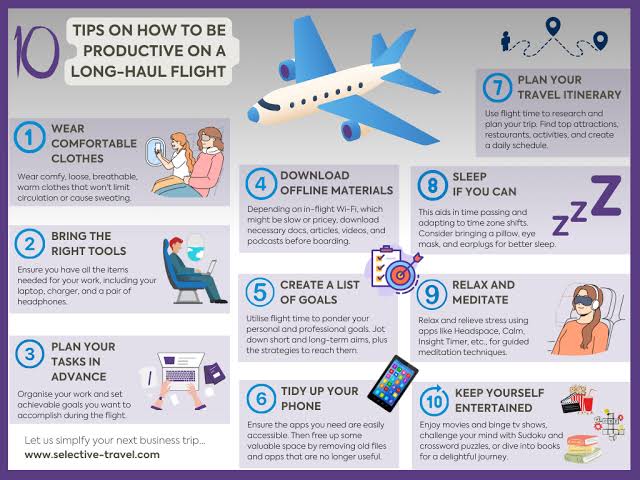
A primary source of failure for traveling executives is failing to match task complexity with circadian biological rhythms and cabin environmental constraints. Hypoxia induced by cabin altitude, combined with sleep debt and dehydration, significantly diminishes executive function, working memory, and complex problem-solving capacity during the latter halves of long-haul sectors. Attempting to draft intricate financial models or negotiate delicate cross-border contracts during periods of peak circadian trough results in errors and inefficiency. True productivity management in flight requires strategic task partitioning—reserving deep, analytical work for periods of high biological alertness and allocating passive transit time for administrative review, reading, or structured rest.
Furthermore, evaluating flight productivity strictly through the lens of digital connectivity creates false dependencies. Modern inflight satellite Wi-Fi systems, while vastly improved, remain subject to bandwidth throttling, high latency, and intermittent dropouts over polar routes or oceanic expanses. Relying on cloud-dependent workflows without offline redundancy guarantees workflow paralysis during connectivity blackout zones. A sophisticated approach treats connectivity as an optional luxury rather than a foundational requirement, ensuring all necessary reference materials, documents, and software tools are locally cached before departure.
Evolution of Cabin Workspaces and Connectivity
The historical development of working during long-haul travel reflects broader shifts in commercial aviation design, telecommunications infrastructure, and corporate management culture. During the mid-twentieth century, intercontinental travel occurred aboard piston-driven aircraft and early commercial jets. Traveling executives worked with physical paper documents, heavy corporate ledgers, and dictaphones. Because aircraft cabins were entirely disconnected from ground headquarters, long-haul flights functioned as uninterrupted sanctuaries for deep reading and strategic planning, free from the constant interruption of telecommunications.
As wide-body aircraft transformed global routes in the later decades, airlines introduced dedicated business class cabins, offering wider seats, increased pitch, and improved lighting. However, working conditions remained constrained by analog technologies. The 1990s and early 2000s introduced laptop computers and early mobile phones, shifting the cabin workspace from paper to digital formats.
The contemporary era is defined by ultra-long-range wide-body aircraft, advanced carbon-fiber cabin pressurization systems that reduce physiological fatigue, lie-flat executive suites, and high-speed satellite broadband. Modern executives navigate a hyper-connected environment where the primary challenge has shifted from accessing information to filtering out digital noise and managing physiological stamina across multi-timezone shifts.
Conceptual Frameworks for Altitude Cognition
Optimizing work output during long-haul transit requires employing structured mental models that account for human biology, environmental friction, and cognitive capacity.
Circadian-Cognitive Alignment
This model maps an executive’s biological alertness curve against the flight’s temporal duration, aligning high-focus tasks with biological peak windows and sleep with circadian troughs. Biological peak windows are characterized by maximum alertness and working memory, ideal for complex drafting. Conversely, circadian troughs represent physiological dips where core body temperature drops and rest should be prioritized.
Offline Redundancy Principle
This model dictates that no critical workflow should depend on continuous, uninterrupted inflight Wi-Fi. Because satellite links fail over remote oceans or during turbulence, all active working documents must be stored locally with active offline synchronization enabled.
Key Categories of Inflight Workflow Management
Managing professional tasks across an intercontinental flight requires categorizing work streams based on cognitive load, digital dependency, and duration.
Deep Strategic Drafting
Executing complex writing or financial modeling without internet connectivity leverages the enforced isolation of offline transit to achieve sustained periods of flow state without digital distractions.
Asynchronous Review and Batch Processing
Rather than attempting real-time communication across unstable satellite links, executives utilize batch processing: downloading messages offline, drafting responses locally, and scheduling automatic sending upon landing.
Conclusion and Strategic Synthesis
Mastering How to Stay Productive on Long-Haul Business Flights requires moving beyond superficial tech hacks to adopt an integrated, systems-based approach to travel management. By aligning task complexity with circadian biology, establishing robust offline digital redundancies, utilizing specialized ergonomic hardware, and strictly protecting data security, intercontinental travel transforms from a draining logistical hurdle into a highly productive strategic sanctuary.
Through disciplined pre-trip preparation, structured energy management, and an understanding of high-altitude physiological constraints, traveling executives can protect their personal well-being while sustaining exceptional professional output across global itineraries. Thoughtful execution turns the challenges of long-haul transit into a distinct competitive advantage in the international business arena.